
The biggest human temptation is … to settle for too little.
To say that I am made in the image of God is to say that Love is the reason for my existence, for God is love. Love is my true identity. Selflessness is my true self. Love is my true character. Love is my name.
All problems are resolved and everything is clear. The rock, all matter, all life, is charged with dharmakaya… everything is emptiness and everything is compassion.
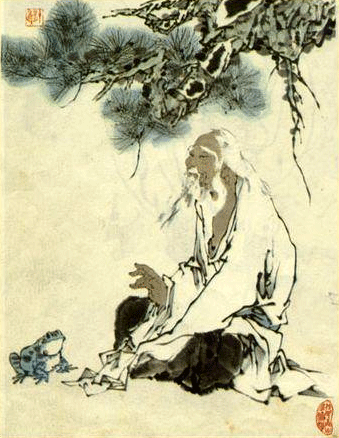
The secret of the way proposed by Chuang Tzu is … not the accumulation of virtue and merit … but wu wei, the non-doing, or non-action, which is not intent upon results and is not concerned with consciously laid plans or deliberately organized endeavors: “My greatest happiness consists precisely in doing nothing whatever that is calculated to obtain happiness . . . Perfect joy is to be without joy . . . if you ask ‘what ought to be done’ and ‘what ought not to be done’ on earth to produce happiness, I answer that these questions do not have [a fixed and predetermined] answer” to suit every case. If one is in harmony with Tao-the cosmic Tao, “Great Tao” — the answer will make itself clear when the time comes to act, for then one will act not according to the human and self-conscious mode of deliberation, but accord ing to the divine and spontaneous mode of wu wei, which is the mode of action of Tao itself, and is therefore the source of all good. The other way, the way of conscious striving, even though it may claim to be a way of virtue, is fundamentally a way of self-aggrandizement, and it is consequently bound to come into conflict with Tao. Hence it is self-destructive, for “what is against Tao will cease to be.”
… it would be a great mistake to confuse the Taoism of Chuang Tzu with the popular, de generate amalgam of superstition, alchemy, magic, and health culture which Taoism later became. The true inheritors of the thought and spirit of Chuang Tzu are the Chinese Zen Buddhists of the Tang period (7th to 10th centuries A.D.). But Chuang Tzu continued to exert an influence on all cultured Chinese thought, since he never ceased to be recognized as one of the great writers and think ers of the classical period. The subtle, sophisticated, mystical Taoism of Chuang Tzu and Lao Tzu has left a permanent mark on all Chinese culture and on the Chinese character itself. There have never been lacking authorities like Daisetz T. Suzuki, the Japanese Zen scholar, who declare Chuang Tzu to be the very greatest of the Chinese philosophers. There is no question that the kind of thought and culture represented by Chuang Tzu was what transformed highly speculative Indian Buddhism into the humorous, iconoclastic, and totally practical kind of Buddhism that was to flourish in China and in Japan in the various schools of Zen. Zen throws light on Chuang Tzu, and Chuang Tzu throws light on Zen.
The whole idea of compassion is based on a keen awareness of the interdependence of all these living beings, which are all part of one another, and all involved in one another.
 One Seeker's Story