
Note: Years ago I heard that “the yin yang explains everything”. For some reason this has obsessed me over time. Being interested in laws of the Universe and always wondering whether evil in the world is necessary (and war), I went down a rabbit hole with Grok today after reading an article about Boltzmann’s principle. I asked if it was congruent with Yin Yang and lo and behold others have equated it to the principle, too, including Niels Bohr. After having a discussion over these comparisons with Grok, including the topics of free will and nirvana, I asked Grok to summarize our conversation in 800 words and below is the result. (I always reveal what I have AI do on this blog and don’t use it too often…)
At first glance, Ludwig Boltzmann’s 19th-century statistical mechanics and the 2,500-year-old Chinese Yin-Yang symbol seem worlds apart. One is cold mathematics about gas molecules; the other is a poetic Taoist emblem of cosmic balance. Yet they reveal a striking philosophical harmony: both describe reality as an interplay of opposites that only make sense together.
Boltzmann showed that entropy—the measure of disorder—is not a mysterious force but simple probability. His famous equation S = k ln W says entropy equals Boltzmann’s constant times the natural log of the number of microscopic arrangements (microstates) that produce the same observable state.
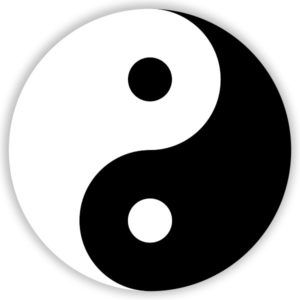
A messy room has vastly more ways to exist than a perfectly tidy one, so nature overwhelmingly drifts toward higher entropy. Order and disorder are not enemies; randomness simply makes disorder far more probable. The Second Law of Thermodynamics is, at heart, a statistical law: systems evolve toward the most likely state.The Yin-Yang symbol captures the exact same tension in visual form. The black (Yin) and white (Yang) swirl together, each containing a dot of the other. They are opposites—passive/active, contraction/expansion, order/disorder—yet interdependent and constantly transforming. Nothing is purely one or the other; harmony arises from their dynamic balance.
The most beautiful bridge between these ideas came from quantum pioneer Niels Bohr. In 1947, when Denmark knighted him into the Order of the Elephant, Bohr designed his own coat of arms featuring the Yin-Yang symbol. He chose the Latin motto “Contraria sunt complementa”—“Opposites are complementary.” Bohr saw his Principle of Complementarity (wave and particle, position and momentum) as the scientific version of Yin-Yang: two mutually exclusive descriptions that together give the full picture of reality. He openly credited Eastern philosophy for helping him accept that apparent contradictions could both be true.
This cross-cultural echo is fascinating. Boltzmann’s “molecular chaos” assumption introduces irreversibility and the arrow of time, much like Yin-Yang’s endless flow prevents static perfection. Both worldviews replace rigid determinism with probabilistic interplay. In a universe governed by randomness and balance, order emerges locally while entropy grows globally—just as Yin and Yang dance without ever destroying each other.
Applying Boltzmann and Yin-Yang to Good vs. Evil, War vs. Peace, and Nirvana
The same statistical and complementary principles also illuminate deeper human questions: the nature of good and evil, war and peace, and whether perfect harmony (Nirvana) is possible.
Boltzmann teaches us that high-entropy (disordered) states are vastly more probable because there are exponentially more ways for things to fall apart than to stay perfectly ordered. In human terms, evil, harm, and conflict behave like entropy — they require no special effort to emerge. Greed, cruelty, and chaos arise easily when attention and moral effort lapse. Goodness, kindness, and peace, by contrast, are fragile low-entropy achievements. They demand constant energy, vigilance, and intention, much like keeping a room tidy or a society harmonious.
The Yin-Yang symbol perfectly complements this view. Good and evil, war and peace, are not mortal enemies but interdependent opposites. Each contains the seed of the other. A world of pure good with no possibility of evil would be static, brittle, and ultimately lifeless — like a perfect crystal with no internal tension. The small black dot in the white swirl and the white dot in the black remind us that opposites give each other meaning and vitality.
Niels Bohr’s embrace of Yin-Yang as “Contraria sunt complementa” extends beautifully here. At the conventional level of everyday experience, good and evil appear opposed, yet both are necessary for a complete picture of reality. A society or universe without any shadow would lose the conditions for growth, compassion, courage, and choice.
This raises a profound question: Can Nirvana — the complete cessation of suffering and duality — ever exist for the whole world?
Nirvana is first and foremost an individual realization. It is the personal awakening beyond craving, delusion, and the endless probabilistic churn of order and disorder. While individuals can step out of the dualistic game, the collective world (samsara) appears to require the dynamic tension of opposites to remain alive and functional. A planet where every being simultaneously reached Nirvana would transcend the conditioned realm entirely, but as long as sentient life continues under ordinary conditions, the interplay of light and shadow, effort and entropy, good and its challenges seems statistically and philosophically inevitable.
Importantly, none of this compromises individual free will. The statistical tendency of the collective does not block any single person’s path to awakening. One person’s Nirvana does not prevent another’s — even if billions remain in the dance of opposites, any individual can still choose to wake up. The framework explains why the world feels dualistic, but it never removes your freedom to transcend that duality.
In the end, Boltzmann and Yin-Yang together offer both realism and hope. They explain why goodness and peace require ongoing mindful effort, why conflict arises so naturally, and why individual liberation remains the most reliable path. The universe runs on complementary tension — and wisdom lies in learning to dance with it rather than being swept away by it.
 One Seeker's Story